General
Why I’m Building penci.ly
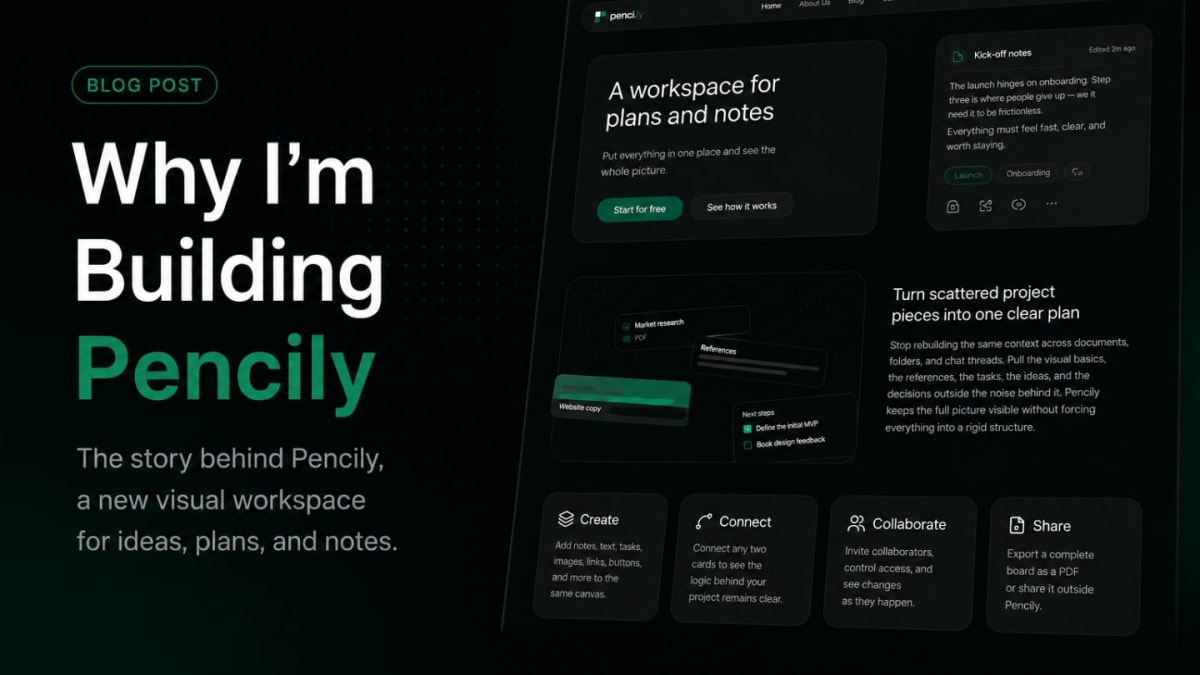
Pencily is being built as a simpler, more enjoyable way to organize ideas visually. I explain the thinking behind the product, the problems it aims to solve, and the kind of creative workspace I want it to become.

3 min read
Creative work rarely begins with a perfectly organized document.
It begins with scattered ideas, screenshots, notes, references, rough plans, unfinished sentences, and connections that only make sense once you can see everything together.
That is why visual workspaces are so useful. They give ideas room to develop before they are forced into folders, pages, or rigid project-management systems.
However, many existing tools come with a compromise. Some are simple and visually pleasant, but feel limited or outdated. Others are powerful, but become expensive, complicated, and crowded with features that many people never need.
Pencily is being built as an alternative.
A Space for Thinking Visually
Pencily is a visual workspace where you can organize ideas using boards, cards, text, images, links, files, and other flexible content.
The goal is not to tell you how your project should be structured. It is to give you a clean, flexible space where you can create your own structure.
A writer could use Pencily to plan characters, scenes, locations, and storylines.
A game developer could organize mechanics, concept art, worldbuilding, dialogue, and production notes.
A student or researcher could collect sources, quotations, arguments, and research questions on a single board.
A content creator could plan videos, campaigns, scripts, references, and publishing schedules.
The same basic workspace can support very different ways of thinking.
Simple Does Not Mean Limited
Pencily is being designed around a simple principle: the interface should stay out of the way.
You should be able to open a board, add something, move it, connect it to another idea, and continue working without navigating through layers of menus.
That does not mean Pencily will be basic. It means its power should come from flexible building blocks rather than unnecessary complexity.
The product will focus on:
Fast and flexible visual boards
Clean, modern, and customizable cards
Smooth organization of text, images, links, and files
Useful templates without forcing users into fixed systems
An interface that feels calm, responsive, and enjoyable
Accessible pricing for individuals and small teams
Every feature should make it easier to think, create, and organize. If it does not, it probably does not belong.
Built for Creative Projects
Pencily is especially focused on the messy early stages of a project.
This is the period when you are still exploring possibilities, collecting inspiration, changing direction, and trying to understand how different ideas fit together.
Traditional documents are often too linear for this. Project-management platforms may introduce structure before the project is ready for it. Large collaborative whiteboards can feel excessive when you simply need a personal creative space.
Pencily aims to sit between these categories.
It is a place where ideas can begin freely and gradually become something organized.
Building in Public
Pencily is still at an early stage.
The product, design, features, and business model will continue to evolve. Instead of pretending that every decision has already been made, I want to document the process openly.
This blog will cover:
Product development and design decisions
New Pencily features and updates
Lessons from building an independent software product
Workflows for writers, developers, students, and creators
The challenges of designing a visual workspace
Ideas about creativity, organization, and digital tools
Most importantly, feedback from early users will help shape what Pencily becomes.
The Beginning
Pencily is not being built to become the most complicated workspace.
It is being built to become the workspace you actually enjoy opening.
A place where ideas feel tangible, projects feel manageable, and creative work feels less scattered.
This is only the beginning.